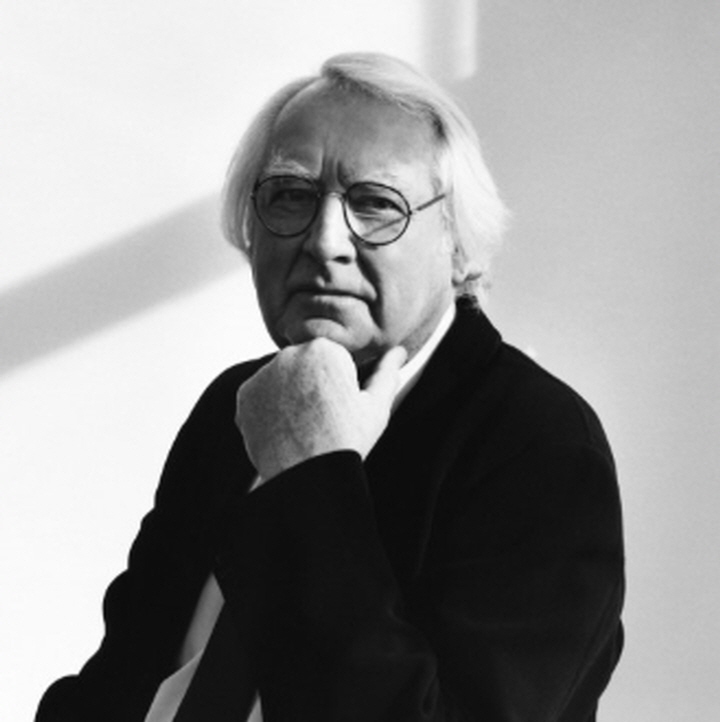
49세의 리차드 마이어는 그의 직업에서 가장 높은 영예인 프리츠커 건축상을 받은 최연소 건축가였다. 그 영예를 받은 직후, 그는 아마도 20세기의 가장 중요한 위원회 중 하나인 J. Paul Getty Trust가 후원하는 로스엔젤레스 예술단지인 The Getty Center의 디자인에 해당하는 상을 받았다.
마이어는 자신의 뿌리를 설명하면서 "레 코르뷔지에가 큰 영향을 미쳤지만 여러 가지 영향이 있어 끊임없이 변화하고 있다. 프랭크 로이드 라이트는 훌륭한 건축가였고, 나는 낙숫물에 압도당하지 않고서는 내 방식대로 부모님의 집을 할 수 없었을 거야." 마이어는 이어 "우리는 모두 르코르뷔지에, 프랭크 로이드 라이트, 알바르 알토, 미이스 반 데르 로에의 영향을 받는다. 그러나 브라만테, 보로미니, 베르니니 못지 않다. 건축은 전통이고, 긴 연속이다. 전통을 깨고 강화하든 우리는 여전히 그 과거와 연결되어 있다고 말했다.
1963년, 그는 자신의 개인 관행을 설립했고, 그의 아파트에서 일하면서 뉴저지 주 에섹스 펠스에 거주하고 있는 그의 어머니와 아버지를 위한 커미션을 가지고 사업을 시작했다. 1965년, 그의 초기 주거 위원회 중 하나인 코네티컷주 다리엔에 있는 스미스 하우스에서 그는 국가적으로 유명해졌다. 지금 그것을 돌이켜보면, 마이어는 "건물의 선명성, 개방성, 민간의 공간과 공공 공간의 직접적 표현, 그것이 땅과 물과 어떻게 관련되어 있는지"에 대해 말했다. 그는 이어 "17년이 넘었는데 그때 혁신적이고 많은 사람들의 상상력과 찬사를 사로잡았던 것은 이미 우리 언어의 일부분이며 오늘날에는 어느 정도 당연한 것으로 받아들여지고 있다."
민간 주택에 대한 다른 수수료도 뒤따랐고, 몇몇 공공 프로젝트도 뒤따랐다. 1967년 그는 383채의 아파트에 1200여 명을 수용하기 위해 맨해튼 그리니치 빌리지에 있는 옛 벨 전화 연구소의 개조 작업을 시작했다. 그 결과는 건축계에서 궁극적으로 마이어의 가장 위대한 업적이 더 큰 규모의 공공사업에 있을 수 있다는 첫 번째 증거로 환영받았다. 마이어는 "이것도 우리가 얼마나 빨리 동화되는지를 보여주는 예"라고 말했다. '적응적 재사용'이라는 문구는 그 당시 언어에도 없었다. 우리는 정말 새로운 분야를 개척하고 있었다."
1979년, 마이어는 거의 5년간의 작업을 마치고 또 다른 작품을 완성했는데, 이로 인해 아다 루이즈 헉스터블은 뉴욕 타임즈에 "확립된 한계를 넘어 도발적으로 현대주의 관행을 전개한다"고 썼다. 이 건물은 인디애나 주 뉴 하모니에 있는 와바시 강둑에 위치한 아테네움으로 알려져 있다.
훨씬 더 큰 규모로 조지아 주 애틀랜타에 있는 하이 뮤지엄은 1983년에 완공되었다. 뉴욕 타임즈의 건축평론가 폴 골드버거는 1983년 6월 보그지에 "그렇다면 리차드 마이어가 박물관의 뛰어난 건축가 중 한 명이 되고 있는 것은 우연이 아니다"라고 썼다.
그는 하이 뮤지엄 외에도 독일 프랑크푸르트 주요 박물관을 설계했으며 아이오와에 있는 데스모인 아트 센터에 추가되었으며, 전 세계의 많은 종류의 위원회를 설계했다.
https://www.pritzkerprize.com/laureates/1984
Richard Meier | The Pritzker Architecture Prize
At 49, Richard Meier was the youngest architect to receive his profession's highest accolade, the Pritzker Architecture Prize. Shortly after receiving that honor, he was awarded what is probably one of the twentieth century's most important commissions, th
www.pritzkerprize.com
At 49, Richard Meier was the youngest architect to receive his profession's highest accolade, the Pritzker Architecture Prize. Shortly after receiving that honor, he was awarded what is probably one of the twentieth century's most important commissions, the design of The Getty Center, the Los Angeles art complex funded by the J. Paul Getty Trust.
Explaining his own roots, Meier says, "Le Corbusier was a great influence, but there are many influences and they are constantly changing. Frank Lloyd Wright was a great architect, and I could not have done my parent's house the way that I did, without being overwhelmed by Falling Water." Meier continued, "We are all affected by LeCorbusier, Frank Lloyd Wright, Alvar Aalto, and Mies van der Rohe. But no less than Bramante, Borromini and Bernini. Architecture is a tradition, a long continuum. Whether we break with tradition or enhance it, we are still connected to that past."
In 1963, he established his private practice, and working from his apartment, launched the business with a commission for his mother and father, a residence in Essex Fells, New Jersey. In 1965, one of his early residential commissions, Smith House in Darien, Connecticut propelled him into national prominence. Looking back on it now, Meier spoke of "the clarity of the building, the openness, the direct articulation of private and public spaces, how it relates to the land and water." He added, "It's been over 17 years, and what was innovative and captured a great many people's imagination and admiration then, is already a part of our language, and somewhat taken for granted today."
Other commissions for private homes followed, along with some more public projects. In 1967, he began work on the conversion of the old Bell Telephone Laboratories in Manhattan's Greenwich Village to accommodate some 1200 people in 383 apartment units. The result was hailed in the architectural community as the first evidence that ultimately, Meier's greatest achievements might lie in larger-scaled more public works. "This too is an example of how quickly we assimilate," said Meier. "'The phrase, 'adaptive re-use,' wasn't even in the language then. We were really pioneering a new area."
In 1979, after devoting nearly five years of work to it, Meier completed another work, which prompted Ada Louise Huxtable to write in the New York Times, that the building advances "conventional modernist practice provocatively beyond established limits." The building referred to is known as The Atheneum, situated on the banks of the Wabash River in the restoration community of New Harmony, Indiana.
On an even grander scale, the High Museum of Art in Atlanta, Georgia was completed in 1983. It opened to enormous media attention and Paul Goldberger, architecture critic of the New York Times, wrote in the June, 1983 issue of Vogue: "It is no accident, then, that Richard Meier is becoming one of the preeminent architects of museums."
In addition to the High Museum, he has designed a major museum for Frankfurt, Germany, an addition to the Des Moines Art Center in Iowa, as well as many other types of commissions around the world.
'프리츠커상' 카테고리의 다른 글
| [프리츠커 수상자]Gottfried Böhm/ 고트프리드 뵘 1986 Laureate (0) | 2020.03.13 |
|---|---|
| [프리츠커 수상자]Hans Hollein/ 한스홀라인 1985 Laureate (0) | 2020.03.11 |
| I.M. Pei / 이오밍 페이 1983 Laureate (0) | 2020.03.11 |
| [프리츠커 수상자]Kevin Roche/ 케빈로치 1982 Laureate (0) | 2020.03.11 |
| [프리츠커 수상자]James Stirling /제임스 스털링 1981 Laureate (0) | 2020.03.11 |


